

Get Weekly Blogs Straight To Your Inbox

The Jar Test: A Simple DIY Soil Texture Analysis
Understanding soil composition is fundamental to successful gardening, farming, and land stewardship. In permaculture, soil health is a primary focus, as it directly impacts plant growth, water retention, and ecosystem balance.
One of the simplest, yet most effective ways to analyse soil texture at home is through The Jar Test. This method provides insight into the proportions of sand, silt, and clay present in your soil, helping you make informed decisions about soil amendments, water management and plant selection.

What Is The Jar Test?
The Jar Test is an easy DIY soil analysis technique that visually separates soil particles based on size and weight. By shaking soil in a jar with water and allowing the particles to settle, you can determine the texture composition of your soil. The results can guide soil management practices, particularly in permaculture where understanding the natural state of the soil is key to designing sustainable, self sufficient systems.
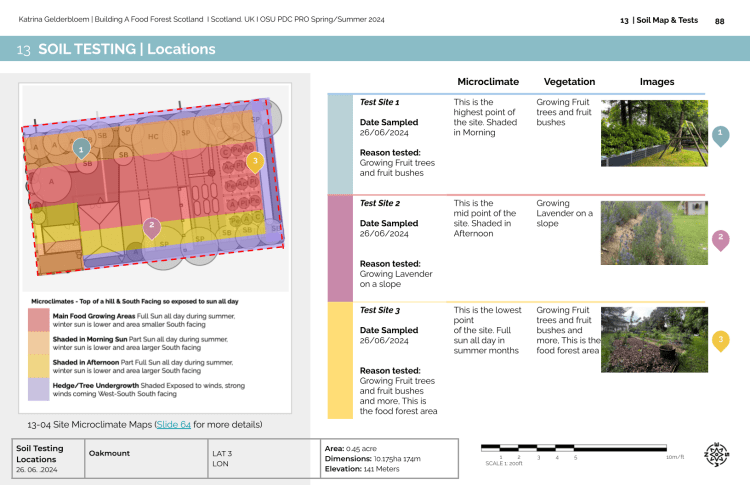
Taken from my PDC PRO Permaculture Design Course Professional portfolio of our jar test done on our land. This is showing the site locations where the 3 samples were taken.
Why Perform a Jar Test?
Performing a Jar Test is useful for several reasons:
Understanding Soil Composition:
Soil texture affects drainage, aeration, and nutrient availability. Knowing your soil’s makeup helps you select appropriate crops and amendments.
Water Retention & Drainage:
Sandy soils drain quickly, while clay heavy soils retain water. By identifying your soil type, you can adjust irrigation strategies accordingly.
Nutrient Availability:
Different soil textures impact nutrient holding capacity. Clay soils retain nutrients better than sandy soils, which may require more organic matter to improve fertility.
Enhancing Soil Health in Permaculture:
By understanding soil composition, permaculturists can tailor their strategies, such as mulching, composting, or planting cover crops, to improve soil structure and function.
Cost Effective & Easy:
Unlike professional lab tests, the Jar Test is free, requires minimal equipment, and provides quick insights into your soil’s properties.
Fun & Educational:
It is interesting to watch the soil form different layers and educational for children and adults alike to gain inside on the soil they will be feeding their family with.
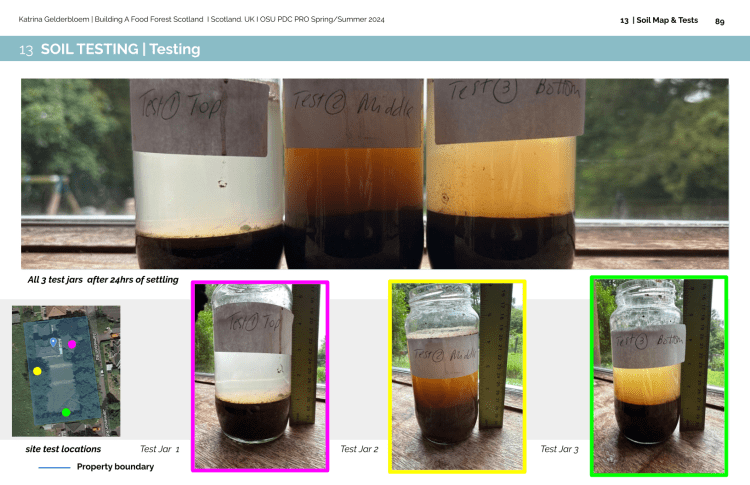
Taken from my PDC PRO Permaculture Design Course Professional portfolio of our jar test done on our land. This is showing the jars from the site locations settling.
How to Perform a Jar Test
Materials Needed:
3 clear glass jars with a lids (we used old sauce jars)
3 soil samples collected from 3 different areas of the areas you wish to plant in.
Water (preferably distilled for accuracy, we just used filtered water through our water filter)
Other: A ruler for measuring & maker pen for labelling the jars (we stuck labels on ours to write on)
Step-by-Step Guide:
Collect the Soil Sample:
Dig about 6 inches into the soil to gather a representative sample.
Remove large debris like rocks, roots, and leaves.
Fill the Jar:
Add soil to the jar until it’s about 1/3 full.
Add Water:
Fill the jar with water, leaving some space at the top.
Shake Vigorously:
Secure the lid and shake the jar for 60 seconds to break up the soil and suspend particles in water.
Let It Settle:
Place the jar on a level surface and let it sit undisturbed for 1-3 days. (ours took 3 days for the water to go fully clear so just wait until it does to get your results)
The soil particles will settle in layers:
Sand: The largest particles will settle within a few minutes.
Silt The medium sized particles will settle within hours.
Clay The smallest particles will remain suspended for the longest time, sometimes taking a day or more to fully settle.
Measure & Interpret Results:
Use a ruler to measure each layer’s depth and calculate the percentage of sand, silt, and clay.
Example: If your total soil depth in the jar is 4 inches, and the layers measure 2 inches (sand), 1 inch (silt), and 1 inch (clay), your soil composition is:
Sand: (2/4) x 100 = 50%
Silt: (1/4) x 100 = 25%
Clay: (1/4) x 100 = 25%
Determine Soil Type:
Use a soil texture triangle to identify your soil type based on the proportions of sand, silt, and clay.
For other tests we are doing take a look at our blog post:
Healthy Soil, Thriving Garden: Checking Soil Condition Tips for Assessing Your Soil Condition, Checking Your Drainage Speed and Checking Your Soil pH.
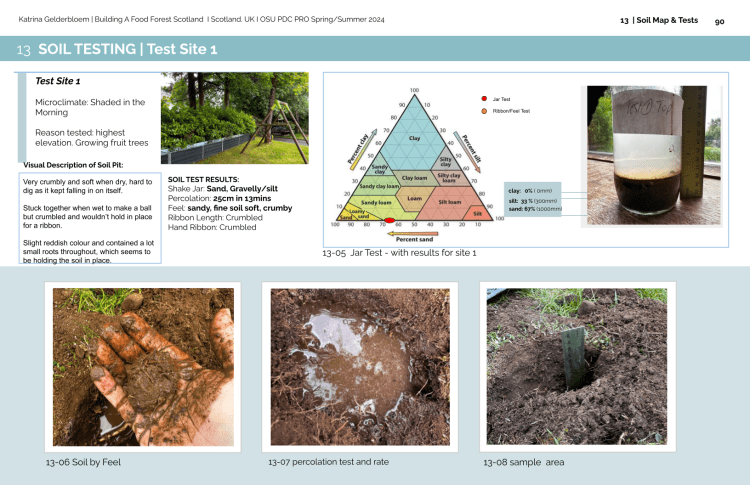
Taken from my PDC PRO Permaculture Design Course Professional portfolio of our jar test done on our land. This is showing the Jar from Site 1 analysis.
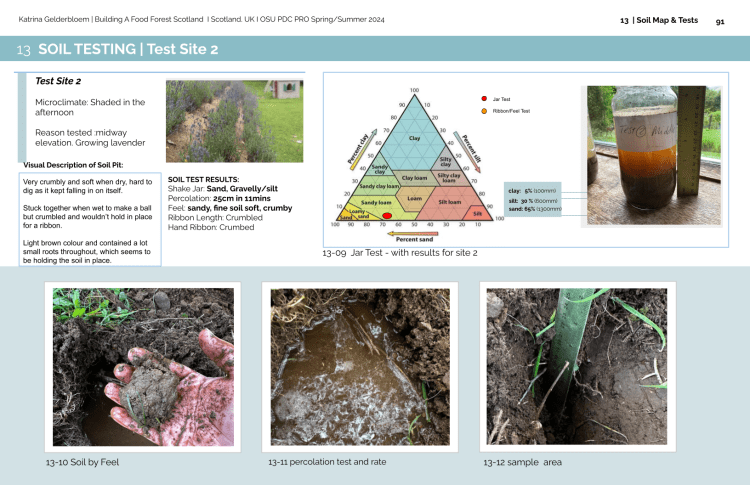
Taken from my PDC PRO Permaculture Design Course Professional portfolio of our jar test done on our land. This is showing the Jar from Site 2 analysis.
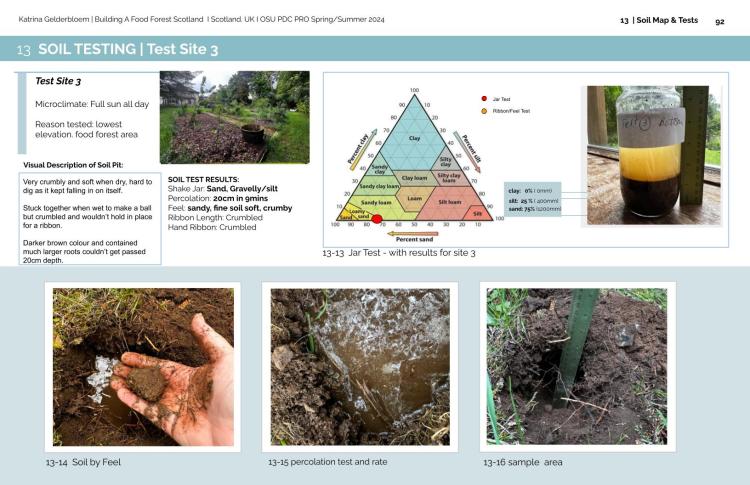
Taken from my PDC PRO Permaculture Design Course Professional portfolio of our jar test done on our land. This is showing the Jar from Site 3 analysis.
The Jar Test & Permaculture
Soil Texture & Permaculture Strategies
Different soil types require different approaches in permaculture design:
Sandy Soil (Over 70% Sand)
Drains quickly and lacks nutrients.
Strategies:
Add organic matter, compost, mulch to improve water retention.
Use drought resistant plants and deep rooted species.
Implement swales or hugelkultur to slow water runoff.
Silty Soil (40-60% Silt)
Holds water well but can compact easily.
Strategies:
Incorporate cover crops to prevent erosion.
Apply organic mulch to maintain soil structure.
Avoid over tilling to reduce compaction.
Clay Soil (Over 40% Clay)
Retains water but drains poorly.
Strategies:
Use raised beds to improve drainage.
Mix in sand or organic matter to break up compacted clay.
Plant deep rooting perennials to aerate the soil naturally. (like comfrey)
Loamy Soil (Balanced Mix of Sand, Silt, and Clay)
Ideal for gardening.
Strategies:
Maintain soil fertility with compost and organic amendments.
Rotate crops to prevent nutrient depletion.
Utilise diverse planting techniques like food forests and polycultures.
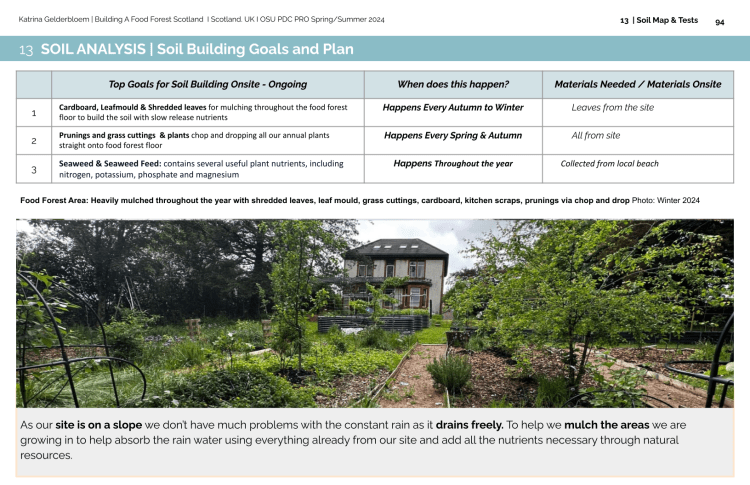
Taken from my PDC PRO Permaculture Design Course Professional portfolio of our jar test done on our land. This is showing what plan we will be doing to help our soil.
The Jar Test is a simple DIY tool for understanding soil composition, essential for anyone practicing permaculture or sustainable gardening. By determining the proportions of sand, silt, and clay in your soil, you can tailor your soil management techniques, improve water efficiency, and build healthier, more resilient ecosystems.
Whether you’re growing food, restoring degraded land, or simply seeking to understand your soil better, this easy test provides invaluable insights, reinforcing the permaculture principle of working with nature, rather than against it.
Happy Gardening!


Katrina & Clayton and family live in East Ayrshire and share their daily life in the garden on instagram. They practice permaculture principles in the garden, reducing & repurposing waste whenever they can. Katrina shows how home educating in nature has helped Clayton thrive.
Clayton Completed The 2 Grow and Learn Courses with the Royal Caledonian Horticultural Society. He is Autistic, Non Verbal & has been Home Educated since 2018. Katrina & Peter hold their PDC & PDC PRO Permaculture Design Course from Oregon State University.
They featured on BBC Beechgrove Gardens Ep23 2022 and returned in 2023 for an update, Katrina & Clayton are also columnists for ScotlandGrows Magazine, Guest Blog for Caledonian Horticulture as well as working with Gardeners’ World Magazine and many other brands.
They are also Author of the new Children’s Book Series: Clayton’s Garden Journey: Stories of Autism and Gardening. Topics on Growing, Harvesting, Sowing & Composting and 108 Page Weather and Seasons Weekly Gardening Record Book available on Amazon and Kindle. Listen in on their Guest Podcasts to learn more about them.

Get Weekly Blogs Straight To Your Inbox
Our Children’s Book Series
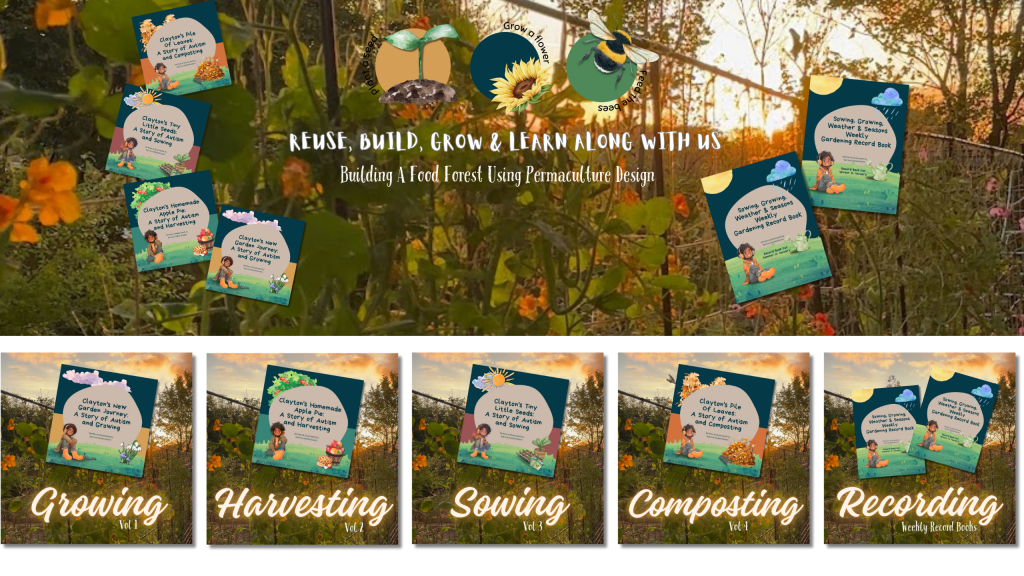
Author of the new children’s book series: Clayton’s Garden Journey: Stories of Autism and Gardening and Sowing, Growing, Weather and Seasons Weekly Gardening Record Book available on Amazon and Kindle
Visit Our Print On Demand Stores
REDBUBBLE STORE -WORLDWIDE
Over 175 Garden & Nature Designs. Coasters, Phone Covers, Bags, Mouse Mats & Much More

Discover more from Building a Food Forest -Scotland
Subscribe to get the latest posts sent to your email.

2 thoughts on “The Jar Test: A Simple DIY Soil Texture Analysis”