

Get Weekly Blogs Straight To Your Inbox

Nitrogen Fixing Plants: Nature’s Soil Builders in Permaculture
Healthy soil is the foundation of a productive garden or farm and nitrogen is one of its key building blocks. Yet, unlike other nutrients, nitrogen is not readily available in the soil in the form that plants can use. Fortunately, nature provides a powerful ally in the form of nitrogen fixing plants, an essential tool in any permaculture system.
What Are Nitrogen Fixing Plants?
Nitrogen fixing plants are species that have developed a symbiotic relationship with certain soil dwelling bacteria. A process, known as biological nitrogen fixation, happens in specialised nodules on the plant’s roots.
Biological nitrogen fixation converts di-nitrogen (N2) into plant-usable form (NH4+ primarily). The process consists of combining N2 with the hydrogen ions from water. Source
While nitrogen makes up around 78% of the atmosphere, plants can’t use it in its gaseous form. Nitrogen fixers bridge that gap, turning unusable atmospheric nitrogen into a biologically accessible nutrient, literally pulling fertility from the air.
Common Nitrogen Fixing Plants
Nitrogen fixers are found in many plant families, but the most well known group is the legumes (family Fabaceae). This includes:
- Beans and peas (Phaseolus, Pisum)
- Clover (Trifolium)
- Alfalfa (Medicago sativa)
- Lupins (Lupinus)
These plants range from annual vegetables to perennial shrubs and trees, giving permaculturists a wide range of tools for different climates and systems.
OUR RAISED BEDS
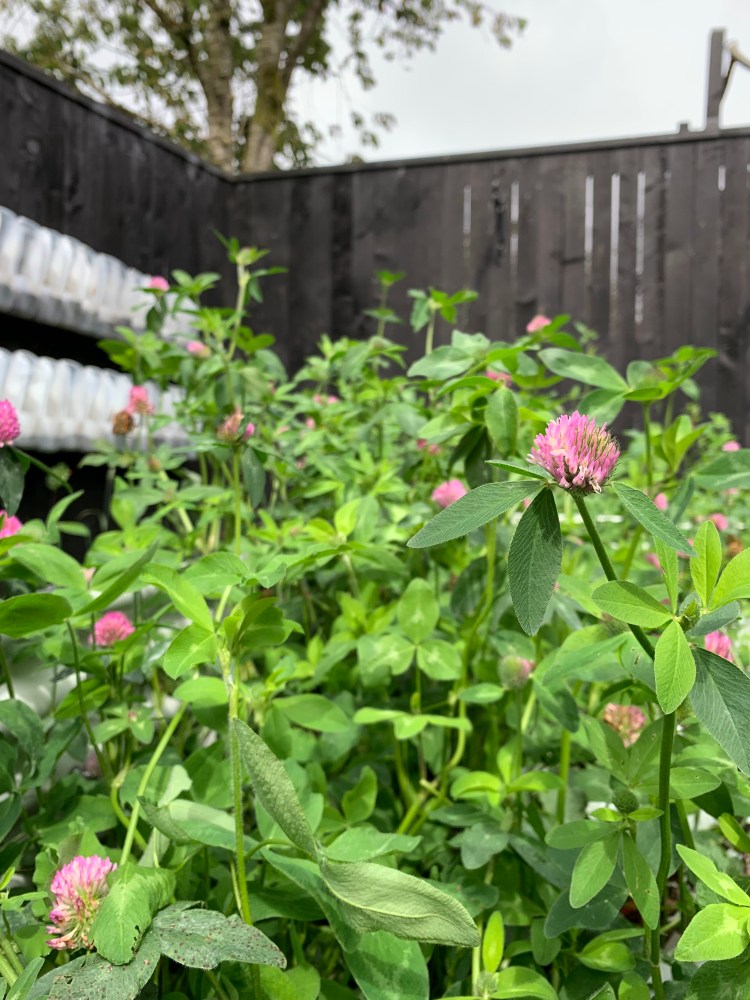
We use green manure for our raised beds over the Winter months, red, crimson clover and field beans. Sown end of season when the beds are cleared out in Autumn and then chop and dropped in Spring before replanting the next crops.
OUR RAISED BED PATH
We use lupins and peas in our raised bed path throughout the year and chop and drop at the end of the season for nitrogen to be pulled in over the Winter. Sown in Spring, grown, harvested and chop and dropped in Autumn to work into the soil over Winter.

OUR FOOD FOREST
We use Seabuckthorn, lupins, clover and Birdsfoot Trefoil (Lotus corniculatus) a low growing legume. Seabuckthorn are large shrubs and left to grow throughout the year. Lupins are left to grow and seeds collected end of each season so they don’t set seed and take over the space. Clover and birdsfoot trefoil and all chopped and dropped at the end of season to over winter into the soil with leaf mould ready for the next season. These mostly come back up each year but more is sown in early Spring to help the next year of soil depletion.

How Nitrogen Fixation Works
The key players in this symbiosis are nitrogen fixing bacteria that live in the soil. When they colonise the roots of a compatible plant, they trigger the plant to form nodules where the bacteria reside. Inside these nodules, the bacteria convert atmospheric nitrogen into ammonia in exchange for carbohydrates from the plant.
Some important facts about this process:
Not all legumes fix nitrogen. They need to be inoculated with the correct strain of bacteria or grow in soils where those bacteria already exist.
Nitrogen fixation is not instant. The plant uses some of the nitrogen for its own growth; only after it dies, is pruned, or drops leaves does that nitrogen become available to other plants.
It’s a mutualistic relationship. The plant gives sugars; the bacteria give nitrogen.
Why Use Nitrogen Fixing Plants in Permaculture?
Permaculture is about designing regenerative, self sustaining systems. Building fertility without relying on synthetic fertilisers is a core principle. Nitrogen fixers help achieve that by:
Restoring Soil Fertility: They improve degraded soils, making them productive again without heavy inputs.
Supporting Polycultures: Interplanting nitrogen fixers with fruit trees, vegetables or grains enhances the productivity and health of the system.
Reducing External Inputs: Using living plants to fertilise the soil reduces reliance on costly and polluting chemical fertilisers.
Providing Multiple Functions: Many nitrogen fixers also offer food, fodder, fuel, timber, bee forage or erosion control, key traits in permaculture’s principle of “each element serving multiple functions.”
How to Use Nitrogen Fixers in a Permaculture System
In Guilds (See Blog Post on Guilds)
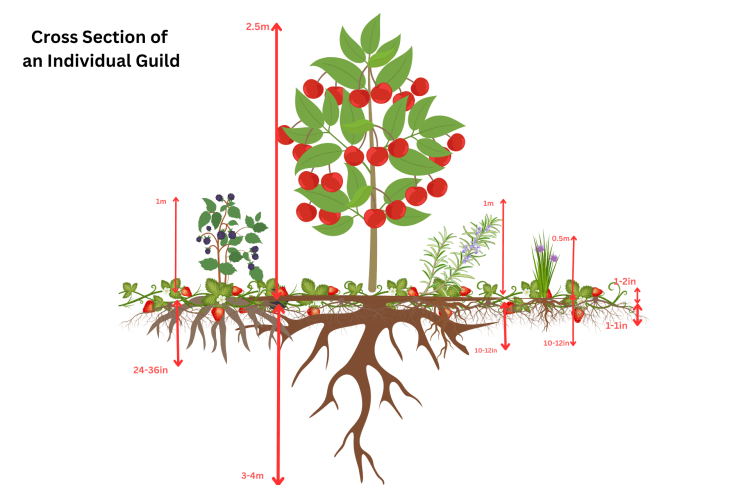
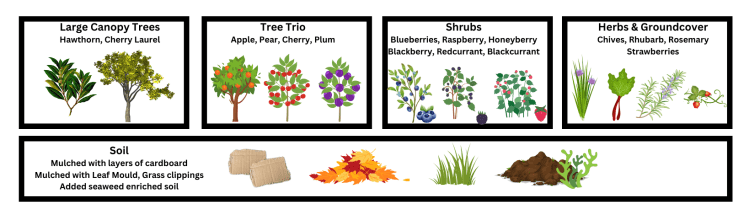
In permaculture, a guild is a group of plants that support a central crop, often a fruit or nut tree. A well designed fruit tree guild might include:
A nitrogen-fixer (e.g., clover or lupin)
A dynamic accumulator (e.g., comfrey)
Ground cover (e.g., creeping thyme)
Pest repellent plants (e.g., garlic)
The nitrogen-fixer boosts soil fertility around the main tree, reducing the need for fertilizer and enhancing tree health.
As Cover Crops (See Blog Post On Cover Crops)
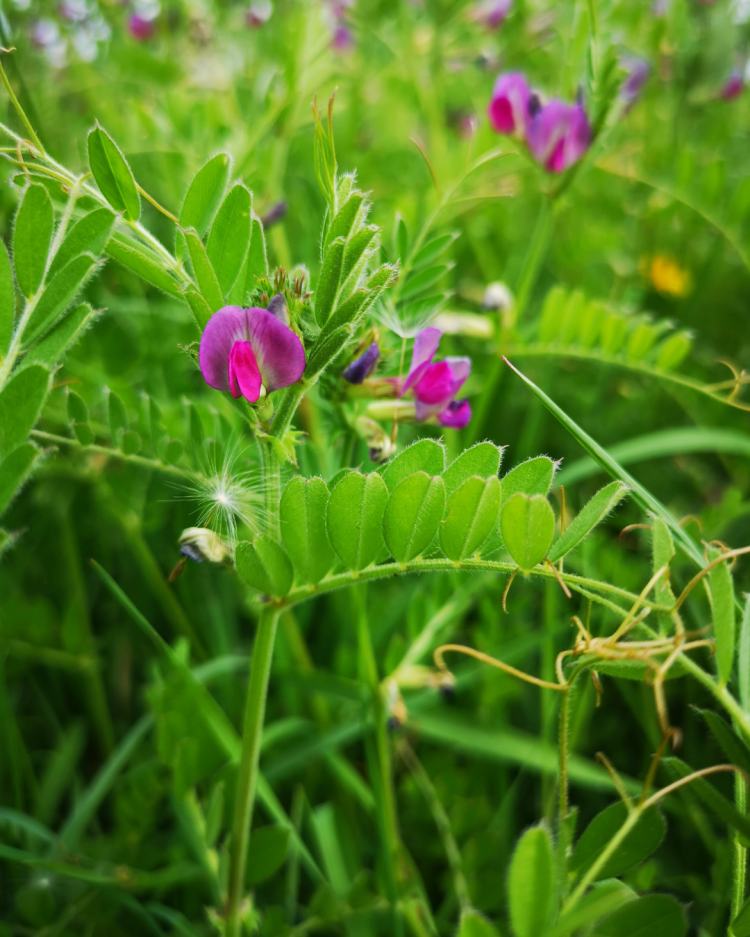
Nitrogen fixing cover crops like clover, vetch or field peas are planted between seasons or in fallow fields to prevent erosion and enrich the soil. When cut and left as mulch or tilled in, they release nitrogen into the soil for the next crop.
In Food Forests
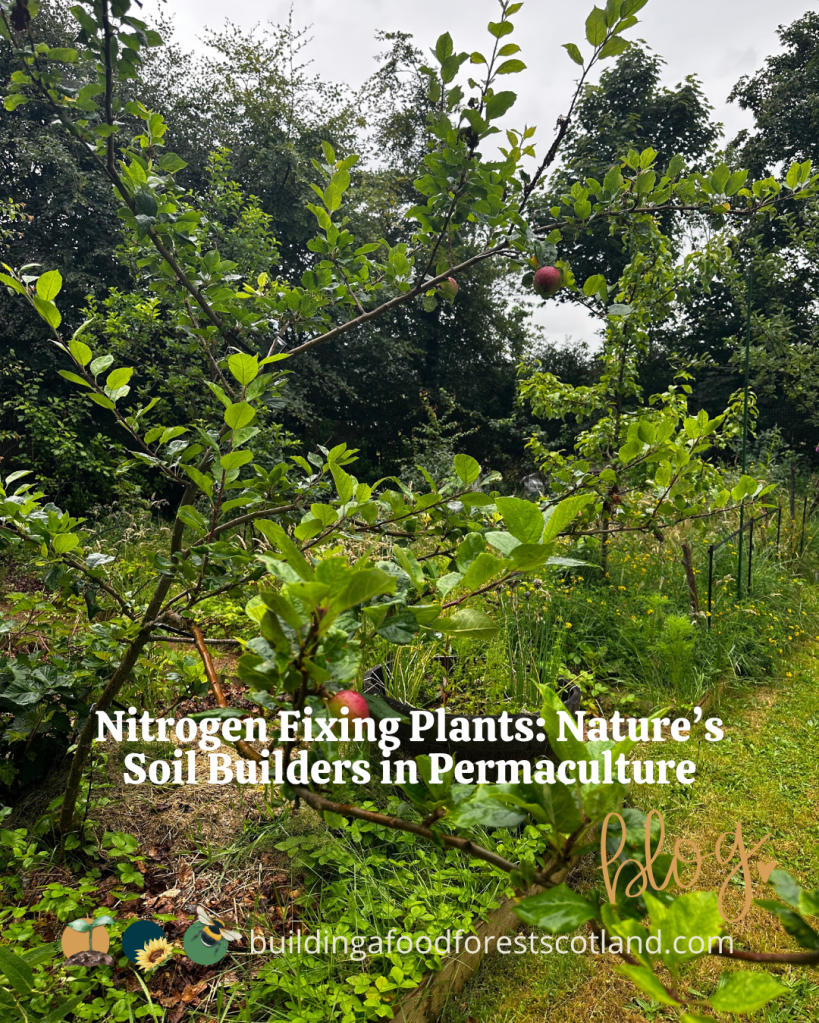
Perennial nitrogen fixing trees and shrubs can be interplanted throughout a food forest. These are examples of what we are using in our food forest in Scotland:
Gorse (Ulex europaeus) – Native
Permaculture use: Protective hedge, chop and drop, early succession
Fixes nitrogen with: Rhizobium
Benefits: Spiny hedge, firewood, wildlife shelter, biomass
Best for: Poor soils, erosion control
Elaeagnus species (Autumn Olive, Goumi, etc.)
Permaculture use: Companion to fruit trees, wildlife attractant
Examples: Elaeagnus umbellata, E. multiflora
Fixes nitrogen with: Frankia
Benefits: Edible fruit, drought tolerance, fertility builder
Best for: Hedges, guilds, edge planting
Sea Buckthorn (Hippophae rhamnoides)
Permaculture use: Edible barrier, wildlife habitat, soil recovery
Fixes nitrogen with: Frankia bacteria
Benefits: Edible vitamin rich berries, sand dune stabiliser, nitrogen fixer
Best for: Coastal zones, sandy or degraded soils
These plants create a nutrient cycle that supports long term productivity.
Permaculture Principles in Action
Nitrogen fixing plants embody several of permaculture’s core ethics and principles:
Care for the Earth: They restore soil health naturally.
Care for People: They produce food, fodder, and fertility without harmful inputs.
Return of Surplus: They cycle nutrients back into the system.
Design principles like “use biological resources,” “integrate rather than segregate,” and “accelerate succession and evolution” all come into play when using nitrogen fixers.
Cautions and Considerations
While nitrogen fixing plants are powerful tools, they aren’t magic bullets. A few tips:
Use species appropriate to your climate and soil.
Don’t over plant aggressive species like lupins or acacia without managing them.
Chop and drop techniques may be needed to release nitrogen back into the system.
Observe before you intervene understand what your soil really needs.

Grow Fertility with Plants, Not Products
In a permaculture system, fertility isn’t something you buy, it’s something you grow. Nitrogen fixing plants are one of the most powerful tools for building soil health, boosting biodiversity, and reducing inputs. Whether you’re growing vegetables in a small garden or stewarding acres of food forest, incorporating nitrogen fixers can help you create a more regenerative, resilient and abundant ecosystem.
Start small. Add some clover under your fruit trees. Sow some field beans or peas as a winter cover crop. Plant a few lupins to break up compacted soil. Observe, interact, and let nature do the heavy lifting.
Happy Gardening!


Katrina & Clayton and family live in East Ayrshire and share their daily life in the garden on instagram. They practice permaculture principles in the garden, reducing & repurposing waste whenever they can. Katrina shows how home educating in nature has helped Clayton thrive.
Clayton Completed The 2 Grow and Learn Courses with the Royal Caledonian Horticultural Society. He is Autistic, Non Verbal & has been Home Educated since 2018. Katrina & Peter hold their PDC & PDC PRO Permaculture Design Course from Oregon State University.
They featured on BBC Beechgrove Gardens Ep23 2022 and returned in 2023 for an update, Katrina & Clayton are also columnists for ScotlandGrows Magazine, Guest Blog for Caledonian Horticulture as well as working with Gardeners’ World Magazine and many other brands.
They are also Author of the new Children’s Book Series: Clayton’s Garden Journey: Stories of Autism and Gardening. Topics on Growing, Harvesting, Sowing & Composting and 108 Page Weather and Seasons Weekly Gardening Record Book available on Amazon and Kindle. Listen in on their Guest Podcasts to learn more about them.

Get Weekly Blogs Straight To Your Inbox
Our Children’s Book Series
Author of the new children’s book series: Clayton’s Garden Journey: Stories of Autism and Gardening and Sowing, Growing, Weather and Seasons Weekly Gardening Record Book available on Amazon and Kindle
Visit Our Print On Demand Stores
REDBUBBLE STORE -WORLDWIDE
Over 175 Garden & Nature Designs. Coasters, Phone Covers, Bags, Mouse Mats & Much More


Discover more from Building a Food Forest -Scotland
Subscribe to get the latest posts sent to your email.

3 thoughts on “Nitrogen Fixing Plants: Nature’s Soil Builders in Permaculture”